

Military service affects far more than the person wearing the uniform. It reaches into the home, shapes family routines, influences important decisions, and asks spouses and children to make sacrifices that may not always be visible to others.
Deployments create long periods of separation. Permanent change of station orders require families to leave familiar communities and begin again. Training schedules can change without warning. Military spouses often manage the home alone while carrying concerns they cannot openly discuss. Children may struggle with repeated goodbyes, new schools, and uncertainty about a parent’s safety.
Practical preparation is an essential part of military life. Families organize documents, review emergency plans, manage finances, update contact information, and prepare for major transitions. Yet even the most detailed checklist cannot answer every fear or calm every anxious thought.
This is why faith-based Books for Military Families can be so meaningful. They address the part of readiness that cannot be packed into a suitcase or measured during an inspection: the spiritual condition of the service member and the family standing beside them.
Lisa Phillips understands this need from personal experience. As a retired military wife, she knows that faith does not remove every hardship. It gives families a foundation strong enough to face hardship without losing hope.
Military readiness usually focuses on physical training, professional responsibilities, logistics, communication, and emergency planning. Each of these areas matters. However, emotional and spiritual readiness are equally important when a family is entering a season it cannot fully control.
A military spouse may know how to manage the household during deployment and still feel overwhelmed by loneliness. A service member may be highly trained for a mission yet struggle privately with fear, exhaustion, or separation from family. Children may understand why a parent must leave but still feel confused, angry, or insecure.
Spiritual preparation helps families respond to these pressures with truth rather than fear. It develops habits that remain steady when circumstances are unpredictable. Scripture, prayer, Christian fellowship, and honest family conversations create an internal support system that military orders cannot take away.
Lisa expresses this message clearly: “Faith makes a difference when confronted with difficult circumstances.” Her book does not suggest that Christians will avoid danger, disappointment, or painful transitions. Instead, it shows readers how to recognize God as their protector, keeper, source of strength, and faithful guide throughout them.
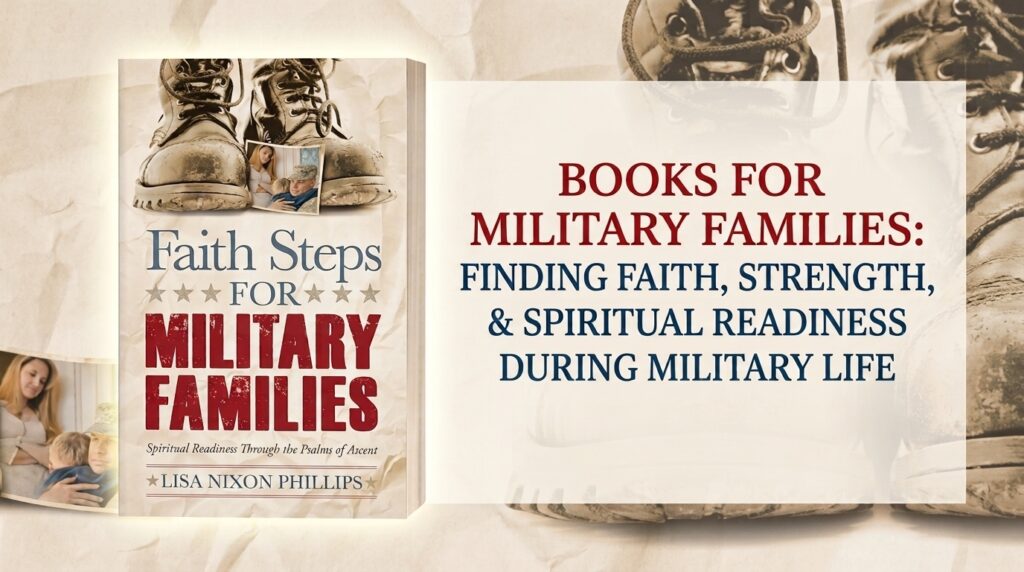
Faith Steps for Military Families was developed around the fifteen Psalms of Ascent found in Psalms 120 through 134. These songs were used by ancient pilgrims traveling through difficult and potentially dangerous territory toward Jerusalem. Lisa connects their concerns about fear, danger, protection, trust, sorrow, family, and perseverance with experiences that remain familiar to military families today.
The Psalms of Ascent present faith as a journey. Each psalm offers another step toward greater trust, spiritual maturity, and awareness of God’s presence. The following lessons are especially relevant during deployments, relocations, family transitions, and waiting seasons.
Psalm 120 begins with a cry of distress. It does not begin with a perfect plan, a quick solution, or an easy road. It begins with someone recognizing trouble and calling upon the Lord.
Military families frequently find themselves traveling through unfamiliar territory, both literally and emotionally. A new duty station may feel isolating. An overseas assignment may separate a family from its established support system. Sudden changes in orders may disrupt school, employment, housing, and carefully made plans.
The lesson of Psalm 120 is not to pretend that these situations are easy. It is to bring distress honestly before God. Lisa’s writing reflects this practical faith. She combines biblical teaching with personal experiences of military housing, separation, family responsibility, and uncertainty. Her message is that there are moments when believers must take God at His Word and trust that He remains present, even when the road ahead is unclear.
Psalm 121 asks, “From where will my help come?” The answer is direct: help comes from the Lord, the Maker of heaven and earth.
For military families, physical distance can magnify worry. A spouse may be waiting at home with limited communication. Parents may be praying for a son or daughter stationed thousands of miles away. Children may wonder whether a deployed parent is safe.
Psalm 121 describes God as the Keeper who does not sleep or abandon His watch. Lisa applies this image directly to military life. She encourages families to renew their minds through Scripture and to treat prayer as part of their readiness training. In the book, prayer becomes a shield through which families place their loved ones into God’s care rather than allowing anxiety to take control.
A simple spiritual readiness routine can include reading a short passage together, choosing a weekly verse, praying at a consistent time, and keeping a written record of answered prayers. These practices do not guarantee that every circumstance will unfold as hoped. They remind the family that fear does not have final authority.
Psalms 127 and 128 focus on the home and family. Psalm 127 teaches that unless the Lord builds the house, human labor is ultimately in vain. Lisa explains that “building the house” includes more than constructing a physical home. It involves everything connected to family life, including relationships, decisions, parenting, priorities, and spiritual values.
A military family may live in several houses, states, or countries over the course of a career. The physical address changes, but the spiritual foundation can remain secure.
A Christ-centered military home is built through consistent choices: praying before major decisions, protecting family communication, extending forgiveness, maintaining integrity, and helping children understand that their identity is not dependent on a duty station or deployment schedule.
Psalm 128 continues this theme by showing that a blessed home is not defined only by favorable circumstances. Lisa distinguishes temporary happiness from the deeper blessing of living with reverence for God. A family can still recognize God’s goodness during an exhausting move, an extended separation, or a disappointing change in plans.
Waiting is one of the most demanding parts of military life. Families wait for orders, housing, phone calls, medical updates, homecomings, promotions, and decisions that affect their future.
Psalm 126 speaks to people living between a good time remembered and a good time still hoped for. Lisa connects the psalm’s image of sowing in tears and returning with joy to the experience of deployment. The goodbye may be painful, and the months apart may be lonely, but tears offered prayerfully can become seeds of endurance, maturity, and future joy.
Faith does not require families to deny sadness. It helps them believe that a difficult season is not the whole story. God can bring renewal from circumstances that feel dry, delayed, or disappointing.
Faith Steps for Military Families is written from inside the military family experience. Lisa is not simply commenting on deployments and transitions from a distance. She supported her husband through his U.S. Navy career, raised children within military life, and experienced the practical and emotional demands placed upon families who serve.
The book combines Scripture, personal accounts, historical and biblical context, prayers, key lessons, and reflection questions. Each chapter gives readers an opportunity to study a Psalm of Ascent and apply its spiritual principle to their own circumstances.
Rather than offering general encouragement alone, Lisa invites readers to build a repeatable practice of spiritual readiness. The book helps families examine their fears, remember God’s past faithfulness, strengthen their homes, pray for protection, and prepare their hearts for uncertain seasons.
Her dedication also reflects the breadth of her connection to military service. She honors her retired Navy husband, a daughter who served in the Army National Guard, and the family members who support those called to serve.
This book is written for people throughout the military community, including:
It can be read individually, together as a couple, during family devotional time, or as part of a military ministry or small-group discussion.
Military families carry responsibilities and sacrifices that are often difficult for others to understand. They live with changing schedules, repeated transitions, physical distance, and questions that may not have immediate answers.
Spiritual readiness does not eliminate these realities. It equips families to meet them with a stronger foundation.
Through the Psalms of Ascent, Faith Steps for Military Families: Spiritual Readiness Through the Psalms of Ascent reminds readers that God is present during the departure, the waiting, the transition, and the homecoming. He remains the Keeper of the service member, the source of strength for the spouse, and the foundation of the family.
For military families seeking faith-based support, Lisa Phillips offers more than encouragement. She provides a path for developing trust, resilience, prayerful readiness, and confidence in God through every season of service.